
My ECG is normal. Could my chest pain still be heart-related?
21
Oct
My ECG is normal. Could my chest pain still be heart-related?
My ECG is normal. Could my chest pain still be heart-related?
Dr. Kulin Sheth, MD, DrNB Cardiology
Interventional Cardiologist
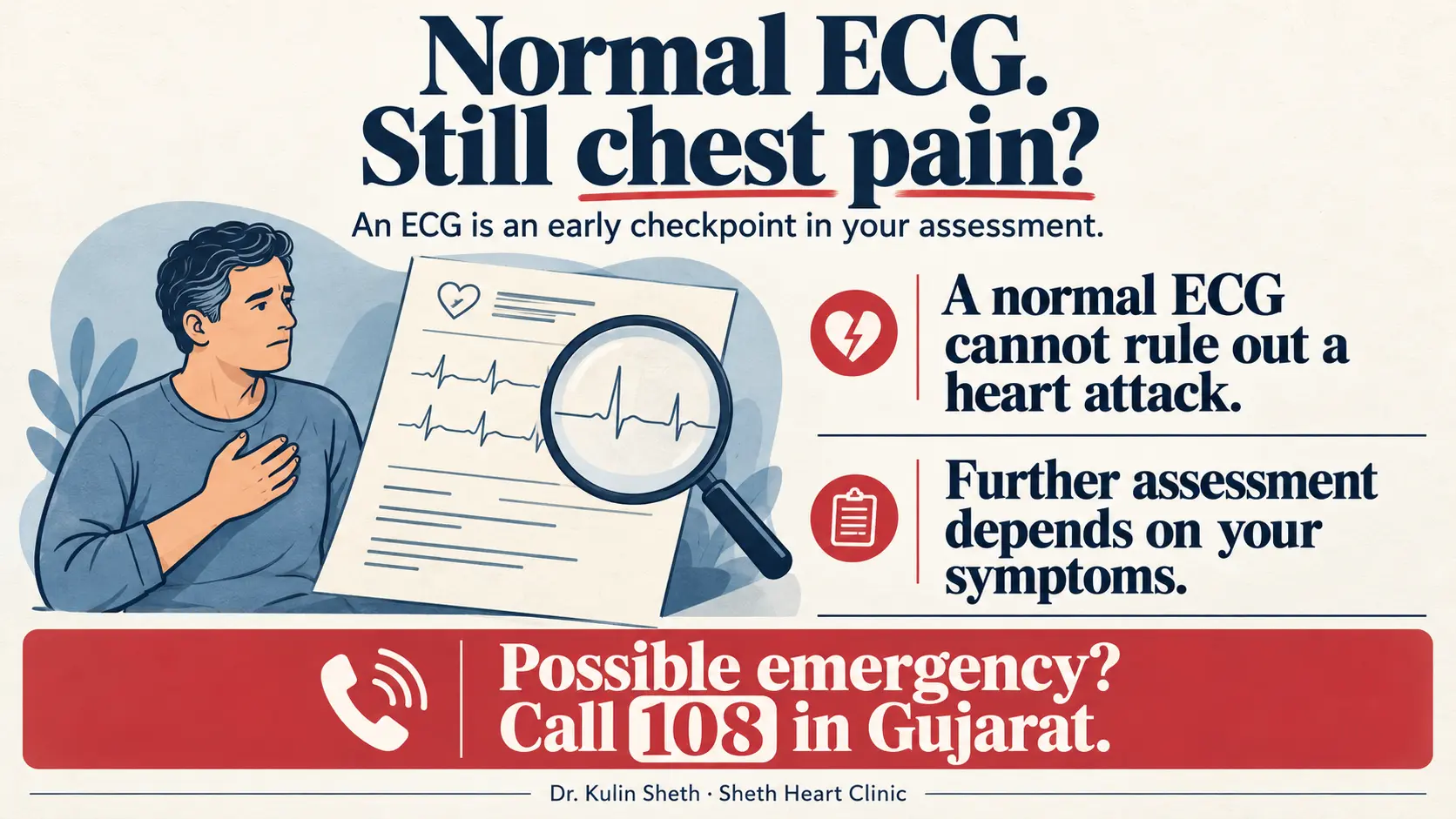
Yes. A normal electrocardiogram (ECG), the recording of your heart’s electrical activity, cannot by itself rule out a heart attack or another heart-related cause of chest pain. Its meaning depends on your symptoms, when it was recorded and the rest of your assessment.
“I have chest pain, but my ECG is normal. What should I do now?”
If you have new, ongoing or recurring chest pressure or discomfort, particularly with sweating, breathlessness, nausea or faintness, seek emergency care immediately. Do not wait for another ECG, a home visit or a WhatsApp reply. A heart attack can begin with mild discomfort.
For emergency medical assistance in Gujarat, call 108, your local ambulance service. Elsewhere, call your local emergency services. Avoid driving yourself.
A normal report can feel reassuring. But if the discomfort continues, or the emergency team recommends observation, you may wonder why further assessment is needed. The reason is that the ECG answers only part of the question.
What does a normal ECG actually tell us?
An ECG helps assess heart rate, rhythm and electrical patterns that may suggest reduced blood supply or heart muscle injury. Some findings can identify a heart attack that needs immediate treatment.
However, an ECG does not directly show whether a heart artery is narrowed or blocked. Some heart attacks do not produce obvious changes on the first recording. People with angina, discomfort caused by insufficient blood supply to the heart muscle, may also have a normal resting ECG.
The result needs to be interpreted alongside your symptoms and examination. The broader chest-pain and heart-attack guide explains warning signs and emergency care.
If my ECG is normal, why was it done in the first place?
Because an ECG can quickly reveal findings that change what needs to happen next. Certain heart-attack patterns can prompt immediate treatment, and important rhythm disturbances may also be detected. Waiting for blood-test results before recording an ECG could delay a treatment decision.
A normal result is useful too: it tells the team that those particular abnormalities were not seen on that recording. It also provides a tracing to compare with later ECGs if your symptoms change. Its value does not depend on finding something abnormal every time.
Think of the ECG as an early checkpoint in chest-pain assessment. Your symptom history, examination and, when appropriate, blood tests and imaging provide other information needed to make a safe decision.
“The ECG is normal, so everything is fine, right?”
That reassurance needs to come from the complete assessment. An ECG records electrical activity; it does not treat the cause of chest pain.
Why does the timing of the ECG matter?
An ECG records what is happening during a short period. Changes may develop as an episode evolves, or become less apparent after symptoms settle. A recording taken during discomfort may therefore provide different information from one taken later.
Tell the treating team when the pain began, whether it was present during the ECG and whether it has returned. An older ECG is useful for comparison, but a normal health-check ECG from last month cannot assess today’s symptoms.
Why might the emergency team repeat tests?
Repeat ECGs look for changes over time
If concern remains, the team may repeat the ECG, particularly if pain persists or returns. Comparing recordings can reveal changes that were absent initially. Repeating the test does not automatically mean your condition has worsened.
Troponin blood tests check for heart muscle injury
Troponin is a protein released into the blood when heart muscle cells are injured. High-sensitivity cardiac troponin tests can detect small amounts and help assess a possible heart attack.
An early result may need repeating. The timing depends on symptom onset, the laboratory test used and the hospital’s assessment pathway. The team considers both the level and any change between samples. A raised troponin also needs interpretation because a heart attack is not its only possible cause.
In selected patients, a single very low high-sensitivity result may be enough when interpreted with symptom timing and a structured clinical assessment. Others need repeat samples or observation. Your treating team will explain whether another sample is needed and when.
Once the complete assessment identifies a patient as low risk, discharge with follow-up may be appropriate without further urgent heart testing.
Can I arrange an ECG at home?
A clinician may recommend a planned home ECG for a stable patient, particularly when travelling is difficult. The recording still needs clinical interpretation and an appropriate follow-up plan.
If you suspect a heart attack, do not book a home ECG and wait for the result before seeking help. A home recording cannot provide the full emergency assessment or exclude a heart attack on its own, even if the report says “normal”.
An ECG performed by an equipped ambulance team is different: it can support assessment while emergency care and transfer are being arranged. Recording or sending an ECG must not delay reaching hospital.
Should I upload my ECG to ChatGPT, Claude or Gemini?
Do not use ChatGPT, Claude, Gemini or another general-purpose AI chatbot to interpret your ECG or decide whether chest pain is safe to manage at home. A confident answer saying “normal ECG” or “no heart attack” cannot safely rule out an emergency.
These tools can produce inaccurate or incomplete medical answers. They cannot examine you, monitor your condition or carry out the blood tests and repeat assessments that may be needed. Even an ECG correctly interpreted as normal does not, by itself, exclude a heart attack.
If you have possible heart-attack symptoms, call [108 in Gujarat (line 108)](tel:108) and seek care at the nearest emergency department. Do not spend time uploading ECG photographs, trying different prompts or asking several chatbots to agree. Bring the ECG with you for the treating team to review.
Can AI help me document my symptoms?
AI can help organise information you provide into a symptom timeline or a short note for your doctor. Check that the summary preserves your account accurately and has not added symptoms or changed their timing. A family member can help with this while care is being arranged, provided it causes no delay.
Use that note to support communication with the treating team. AI documentation cannot replace emergency assessment or treatment.
What if the pain has settled but keeps returning?
Pain settling does not, by itself, establish that the episode was harmless. Recent unexplained discomfort may still need urgent assessment, especially if episodes are new, more frequent or occurring with less effort.
For recurring symptoms after an emergency has been excluded, the next step is to understand the pattern. Discomfort during walking or climbing stairs, for example, may need a different investigation from pain consistently related to another activity.
“It must be gas” is an understandable explanation to consider. Reflux and muscle pain are possible causes, but neither a normal ECG nor your description alone is enough to make that distinction safely.
Do I need an echo, treadmill test or angiography?
Further testing can be important because different tests answer different questions. An ECG looks at electrical activity, troponin blood tests assess heart muscle injury, and selected imaging or stress tests can help assess heart structure or blood supply. One normal result cannot answer all of those questions.
If the clinical assessment still raises concern, stopping at a normal ECG may leave an important cause unexplained. The next test should address that concern and help guide treatment. The team should explain what it is looking for and how the result would change your care.
This is an individual pathway. Some patients need further investigation; others can be reassured after an appropriate assessment. You do not automatically need every test because the first ECG was normal.
| Test | What it may help clarify |
|---|---|
| Heart ultrasound, called an echocardiogram or echo | Heart pumping, wall movement, valves and some other possible causes. A normal resting echo does not exclude every coronary artery problem. |
| A supervised treadmill test or stress imaging | Whether exertion or controlled stress reveals evidence of insufficient blood supply in an appropriately selected patient. A treadmill test is not a substitute for emergency assessment of suspected acute heart attack. |
| Computed tomography coronary angiography, a CT scan of the heart arteries | Whether there is plaque or narrowing in selected patients who need further assessment. |
| Catheter coronary angiography | Detailed assessment of the arteries when the clinical findings justify an invasive test. A normal ECG alone neither requires nor rules out angiography. |
The cardiac-test guide explains ECG, echo and treadmill testing. If an invasive artery test has been advised, the coronary angiography page explains what it involves.
What should I bring to a follow-up consultation?
Bring the actual ECG tracings, blood-test reports with collection times, any discharge summary and your current medicine list. Older records can help the comparison.
Note when the discomfort occurs, how long it lasts, what you were doing and any accompanying symptoms. Record whether pain was present during testing. You do not need medical language to explain what happened.
Collecting records should never delay emergency care.
Frequently asked questions
My ECG and echo are both normal. Can my pain still be heart-related?
Yes. These tests provide different information, but normal results do not exclude every cause of reduced blood supply to the heart. Whether you need further investigation depends on the symptoms and overall assessment.
Does everyone with chest pain need repeat troponin tests?
No. The decision depends on whether a heart attack is suspected, the timing of symptoms and the testing pathway. Follow the treating team’s advice rather than arranging a fixed series yourself.
The machine printed “normal ECG”. Does that settle the result?
No. Automated interpretation can miss important findings or mislabel them. A clinician needs to review the tracing in the context of your symptoms.
Understand what your normal report means for you
A normal ECG is useful information. The question is whether your symptoms and the complete assessment support reassurance, follow-up or further investigation.
For a non-emergency concern, Dr. Kulin Sheth can review your symptoms and reports at a cardiologist consultation. If further testing or angiography has been advised and you are clinically stable, a second opinion can help clarify the reason for that recommendation. Do not postpone urgent care to obtain one.
Sheth Heart Clinic
818, 8th Floor, Anam 2, Beside Vakil Sahib Bridge, Next to Amrapali Axiom, Bopal Ambli T Junction, Ahmedabad 380058.
Call +91 97255 51563 · WhatsApp +91 97255 51563
This article provides general patient information. Your symptoms and clinical assessment determine which tests and treatment are appropriate for you.
References
- NICE: Recent-onset chest pain of suspected cardiac origin, assessment and diagnosis. Guidance on ECG limitations, urgent referral and avoiding delays in hospital transfer.
- American Heart Association and American College of Cardiology: 2021 Chest Pain Guideline, official slide set. Recommendations on symptom assessment, troponin testing and selecting further investigations.
- American College of Cardiology: Key points from the 2022 Expert Consensus Decision Pathway on acute chest pain. Guidance on repeat ECGs, high-sensitivity troponin pathways and decisions about observation or discharge.
- EMRI Green Health Services: 108 emergency services. Information about the emergency response service operating in Gujarat and other participating states.
- World Health Organization: Guidance on large multi-modal AI models in health, January 2024. Explains potential uses in documentation and the risks of inaccurate or incomplete answers when AI is used for health decisions.
Google Reviews
Read what our patients say about us
Book a Consultation
Reach Dr. Kulin Sheth's team directly by phone or WhatsApp, or visit us at Sheth Heart Clinic, Bopal.