
Why is my blood pressure higher at the clinic than at home?
22
Oct
Why is my blood pressure higher at the clinic than at home?
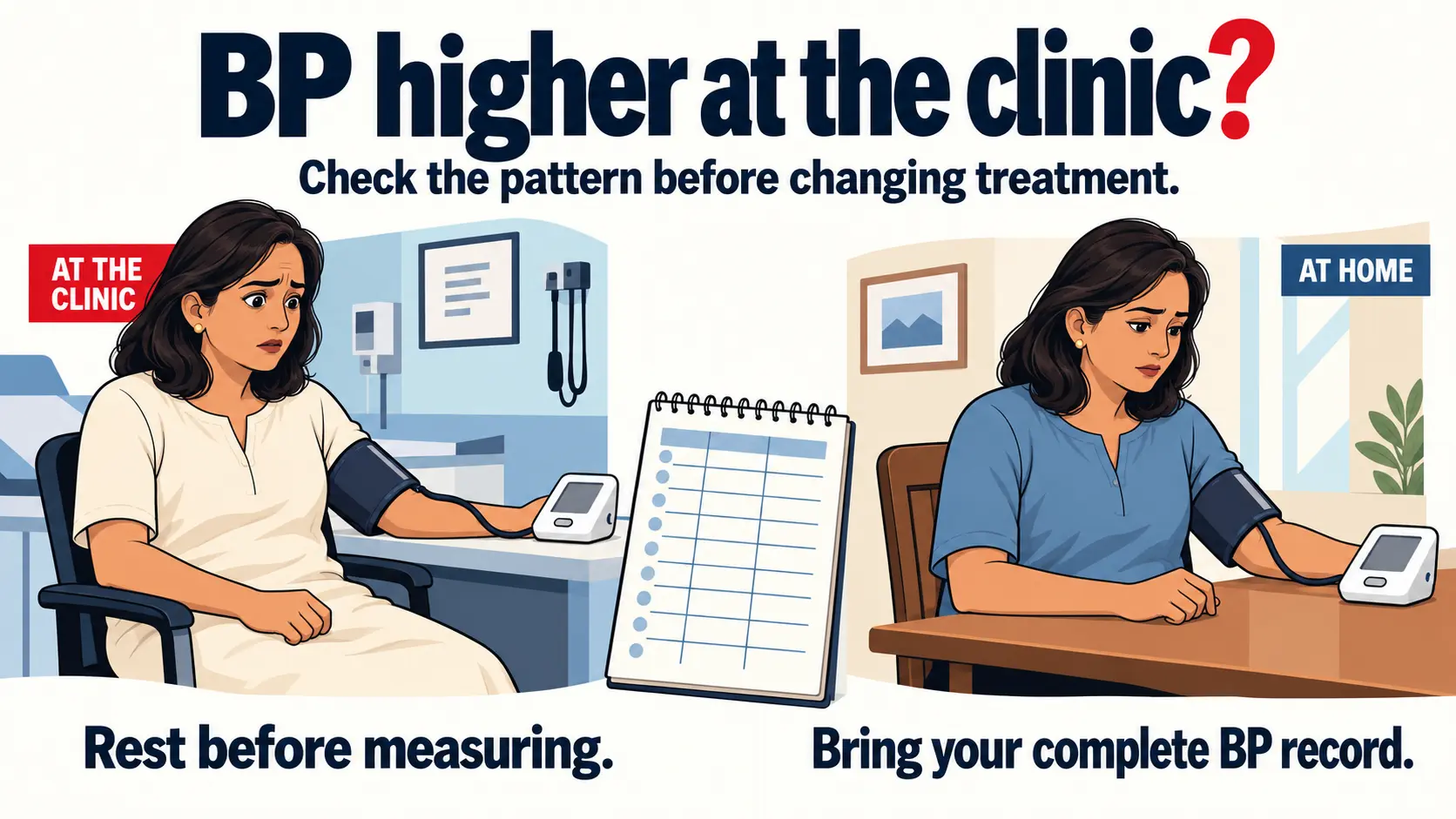
Clinic blood pressure (BP) can be higher because of a white-coat effect, recent activity or differences in measurement technique and medicine timing. Lower home readings help clarify the pattern, but do not automatically mean the clinic reading is wrong or treatment is unnecessary.
“Ghare toh BP normal aave chhe.”
“My BP is normal at home.”
Bring the record. The next step is to check how both sets of readings were taken and whether further monitoring would help.
Why can the readings be different?
Blood pressure, or BP, changes through the day. Common reasons for different readings include:
- Recent activity: walking from your vehicle or climbing stairs before the appointment can temporarily raise BP. Tell the staff and rest quietly, seated, for at least five minutes. If you are still recovering from exertion, more time may be needed before repeating it.
- Measurement conditions: talking, crossed legs, an unsupported arm, an unsuitable cuff or using different arms can affect the comparison.
- Other temporary influences: pain, a full bladder, tea or coffee, tobacco and worry about the visit, even without obvious anxiety.
- Device reliability: use a validated automatic upper-arm monitor with the correct cuff size. Validation means the model has passed recognised accuracy testing. Bring it for a check if results seem inconsistent.
Record raised readings rather than dismissing them as exercise or anxiety. Watch and phone estimates should not replace cuff measurements for treatment decisions.
Should blood pressure be checked in both arms?
Both arms should usually be checked at the initial assessment. You do not normally need both-arm measurements every time at home.
- Small differences can occur between measurements; larger differences should be repeated.
- NICE guidance recommends subsequent checks in the higher-reading arm if a difference above 15 mmHg persists on repeat measurement. Persistent differences deserve review because they can sometimes reflect reduced blood flow to an arm.
- Use the arm agreed with your clinician consistently. Do not choose the lower-reading arm or average the two arms together.
- Tell the clinician if an arm should not be used for BP measurement.
What is white-coat hypertension, and is it normal?
White-coat hypertension means repeatedly raised clinic BP with normal out-of-office BP in someone not taking BP medicines. It is not the same as consistently normal blood pressure. Confirm it with reliable home or ambulatory monitoring, rather than one reassuring home reading.
- Follow-up matters: untreated white-coat hypertension has been associated with higher cardiovascular risk in pooled observational studies. Risk varies, and some people develop sustained hypertension, with high readings outside the clinic too.
- Tablets are not automatic: treatment depends on confirmed readings, overall risk and evidence of heart or kidney effects. Evidence supporting routine tablets for everyone with isolated white-coat hypertension remains limited.
- During treatment: higher clinic readings with controlled readings elsewhere are usually called a white-coat effect. Increasing tablets unnecessarily could make everyday BP too low. The risk findings for untreated white-coat hypertension do not automatically apply to this treated pattern.
Masked hypertension is the reverse: clinic readings look normal but readings outside it are high. Similar hidden poor control can occur during treatment.
Can the timing of my tablets change the reading?
Yes. A reading before a scheduled dose may differ from one taken after the medicine has had time to work. The effect depends on the medicine, its duration and your BP pattern. One reading cannot establish whether a long-acting medicine provides adequate daily coverage.
- Record measurement times and when you took your tablets. Missed doses and changed routines matter too.
- For a standard morning record, clinicians commonly request readings before breakfast and the scheduled morning BP dose. Agree on timing around your prescription, night doses or shift work. Do not skip or delay treatment to collect readings.
- Report repeatedly high readings before the next dose or dizziness after treatment. Do not take extra tablets or move medicines to bedtime yourself.
How can I make a useful home BP record?
- Avoid tobacco, caffeine and exercise for 30 minutes beforehand. Empty your bladder.
- Rest quietly for five minutes: back supported, feet flat, legs uncrossed.
- Place the correct cuff on your bare upper arm, supported at heart level. Stay silent.
- Use the agreed arm. Take two readings at least one minute apart and record both.
For diagnosis: one established protocol uses morning and evening readings for at least four days, ideally seven. Exclude day one from the diagnostic average, but retain the complete record. Your clinician may choose another supported protocol; stable treatment does not require twice-daily monitoring indefinitely.
Record the date, time, both readings, medicine timing and symptoms. Keep higher readings too, and bring the monitor's stored history if available.
Can AI help me keep track of my BP?
Yes, as a scribe. ChatGPT, Claude or Gemini can organise typed or dictated cuff readings by date and time, alongside medicines and symptoms.
- Check every entry against the original record. Transcription and summaries can swap numbers or omit unusual readings.
- Verify any calculated average and which readings it includes. Retain the originals for your clinician.
- Avoid unnecessary identifying details, such as your name or phone number.
- AI cannot measure BP, confirm white-coat hypertension or decide medicine changes. Urgent symptoms or very high readings need medical action, without waiting for a chatbot.
Can I use an Apple Watch, Galaxy Watch Ultra or another smart device?
Smart devices can support awareness, recording and sharing. Their BP features do different jobs:
| Device or feature | Useful role and important limits |
|---|---|
| Apple Watch hypertension notifications | On supported models, software and regions, the feature looks for patterns suggesting hypertension over 30-day periods. It does not provide an upper and lower BP reading. It is intended for eligible adults aged 22 or older who are not pregnant and have not already been diagnosed with hypertension. An alert is a reason to obtain cuff readings and discuss them with a clinician. No alert does not prove your BP is normal. |
| Samsung Galaxy Watch Ultra and other compatible Galaxy Watches | Where enabled, Samsung Health Monitor provides cuffless BP estimates after calibration with an upper-arm cuff monitor. Samsung requires recalibration every 28 days. You need a compatible Galaxy phone and supported software; follow the app's eligibility, positioning and resting instructions. The record may be useful to share, but should not replace cuff measurements when diagnosing hypertension or adjusting treatment. |
| Other watches, rings and phone-camera BP apps | Check whether the feature measures BP, estimates it or merely displays readings entered from another device. Accuracy evidence and approved uses vary. A displayed number, regulatory permission for a particular use or agreement with a cuff on one occasion does not establish that every reading is reliable for treatment decisions. |
| A validated upper-arm cuff monitor that connects to an app | This still measures BP using a cuff. Automatic saving can reduce copying errors and make sharing easier. Check the exact model's validation, cuff fit and technique; Bluetooth connectivity itself does not establish accuracy. |
To resolve clinic–home differences, use a validated upper-arm cuff record or clinician-arranged ambulatory monitoring. Current American Heart Association guidance advises against cuffless devices for diagnosing hypertension or guiding treatment until reliability improves.
- Label watch results separately; do not combine them with cuff readings in one average.
- Confirm concerning estimates with your cuff and discuss persistent differences.
- Check manufacturer restrictions, particularly with heart disease or an irregular rhythm.
- Do not stop tablets or delay symptom assessment because a watch looks reassuring.
When does a 24-hour BP monitor help?
Ambulatory blood-pressure monitoring, or ABPM, records BP through an arm cuff at intervals during daily activities and sleep, generally over 24 hours.
It may help resolve:
- Conflicting or uncertain clinic and home records.
- Possible nighttime hypertension or episodes of low BP.
- Apparently difficult BP control.
A usual home diary cannot show sleeping BP. ABPM can disturb sleep, and movement can spoil readings; interpretation needs enough valid measurements and your sleep, activity and medicine times. It is useful selectively, not compulsory for every raised clinic reading.
What BP range should I aim for?
- Systolic: the upper number, when the heart pumps.
- Diastolic: the lower number, between beats.
- mmHg: millimetres of mercury, the measurement unit.
Diagnosis, treatment targets and emergency assessment use numbers for different purposes. A home reading lower than your clinic reading may still exceed your target.
The 2025 American guidance defines normal BP as systolic below 120 and diastolic below 80. That classification does not mean everyone taking tablets should aim below 120/80.
Current treatment guidance includes:
| Guidance | Treatment goal and qualification |
|---|---|
| American Heart Association/American College of Cardiology, 2025 | Below 130/80 mmHg for most adults receiving treatment, with individual considerations. |
| European Society of Cardiology, 2024 | A treated clinic range of 120–129 systolic and 70–79 diastolic for suitable adults, provided treatment is tolerated. |
| American Diabetes Association, 2026 | Below 130/80 if safely achievable. A systolic goal below 120 is encouraged for people with diabetes who have high cardiovascular or kidney risk, with individual assessment and monitoring. |
These goals require individual assessment:
- Agree on separate clinic and home targets where appropriate; do not calculate one by subtracting a fixed number from the other.
- Frailty, standing dizziness, falls, kidney function and side effects affect what is safe. Pregnancy needs separate assessment.
- Do not start or adjust tablets after one reading, or chase the lowest possible number.
See high blood pressure and your heart for broader diagnosis and long-term care.
Why might diabetes lead to earlier treatment or a tighter target?
Diabetes increases heart, blood-vessel and kidney risk. Persistent raised BP adds to that risk, so earlier treatment may offer more benefit.
- The 2026 American Diabetes Association guidance recommends medication for confirmed office systolic BP of 130 or higher, or diastolic BP of 80 or higher. Suspected white-coat readings need clarification with reliable out-of-office measurements.
- A goal below 130/80 also applies to many people without diabetes. Selected people with diabetes and high cardiovascular or kidney risk may benefit from tighter systolic control, as shown above.
- Intensive treatment needs supervision for low BP, kidney-function changes and electrolyte disturbances. Diabetes-related nerve damage can also cause standing BP drops, making dizziness and standing measurements relevant.
Your heart and diabetes care teams should coordinate the plan. See diabetes and heart disease for the wider approach.
Does the difference mean my treatment should change?
- Outside-clinic BP controlled: consider monitoring before automatically increasing tablets.
- Home or ambulatory averages high: treatment may need adjustment.
- Low readings or dizziness: review treatment safety.
- Normal readings while taking tablets: treatment may be working; they do not show what BP would be without it.
Keep taking prescribed medicines unless your treating clinician advises a change.
When should I seek urgent help?
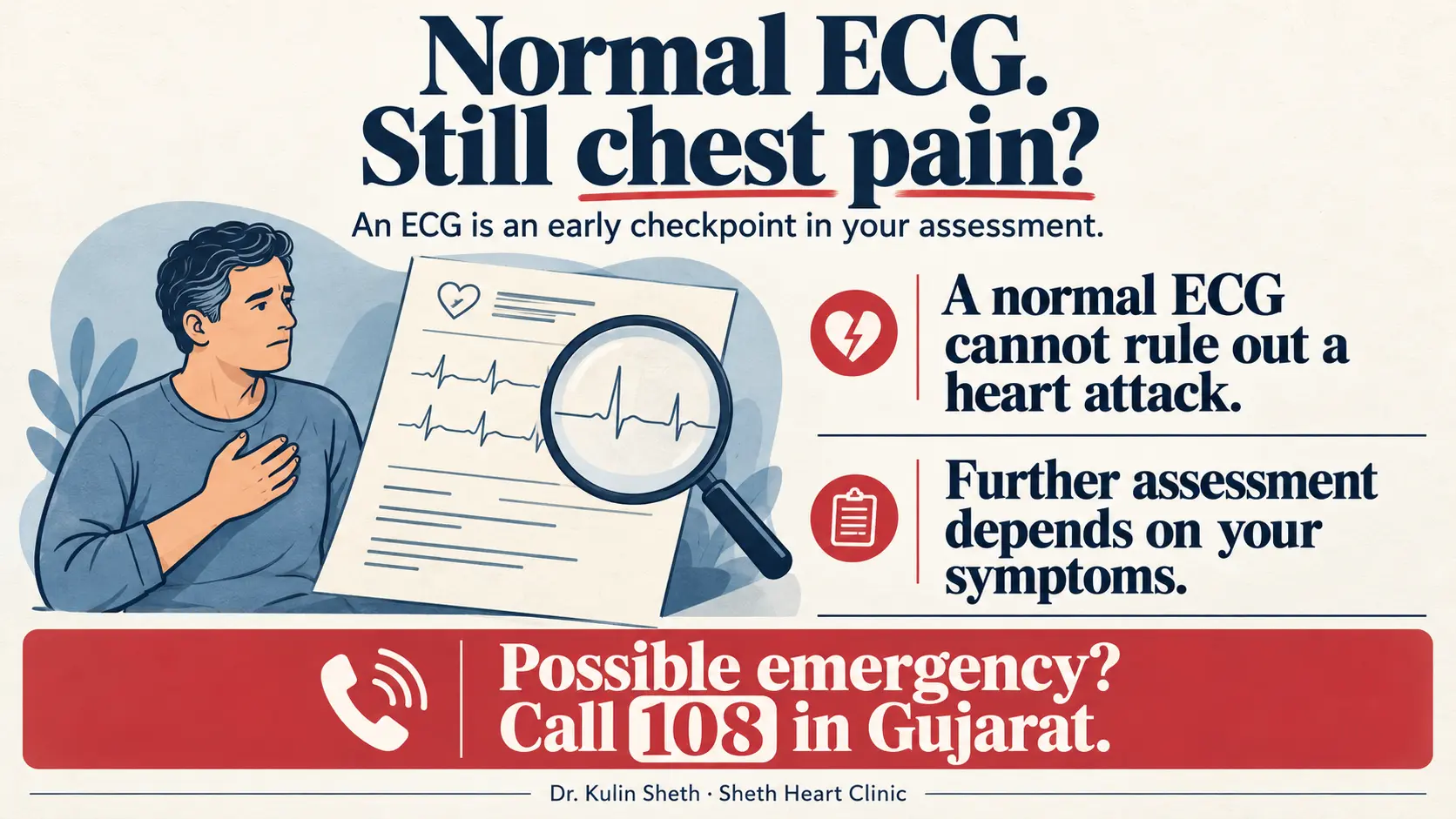
Seek emergency care for chest pain, severe breathlessness, new weakness or numbness, difficulty speaking, confusion, collapse, or a sudden severe headache or major vision change. Act even if BP is below an emergency threshold. In Gujarat, call 108; elsewhere, call your local emergency service. Do not wait for repeat readings, appointments or WhatsApp replies.
If otherwise well, but systolic BP is 180 or higher or diastolic BP is 120 or higher:
- Sit quietly and repeat after at least one minute.
- If still this high, obtain urgent medical advice the same day. If a clinician is not promptly available, seek urgent in-person assessment.
- Do not assume a white-coat effect or take extra tablets without advice.
Frequently asked questions
I feel calm at the clinic. Can there still be a white-coat effect?
Yes. Feeling calm does not exclude it. Confirmation depends on correctly measured clinic and out-of-office patterns.
Is a digital monitor less accurate than a manual BP check?
A validated automatic upper-arm monitor can be reliable with correct technique and cuff fit. Manual checks also depend on equipment and technique. Bring your monitor for comparison if readings consistently disagree.
Should I keep measuring until I get a normal result?
No. Keep both readings from each planned session. Repeated checking to obtain a preferred number can increase worry and hide the useful pattern. Follow the urgent-action advice above when needed.
If white-coat hypertension is confirmed, can I stop follow-up?
No. Agree on follow-up and repeat monitoring based on your readings and risk. Seek earlier review if the home pattern changes or symptoms develop.
Bring the readings. We can work out what they mean.
A BP review should leave you clear about which arm to use, when to measure, your target and when to seek help.
Bring your complete diary, monitor, prescriptions and any ambulatory report to a consultation with Dr. Kulin Sheth. A non-emergency second opinion can help if a proposed medicine increase conflicts with lower home readings. Dr. Kulin personally reviews existing reports and records before deciding whether further assessment is needed.
Medically reviewd by Dr Kulin Sheth, MD, DrNB Cardiology
Last updated on - 22-10-2026
Sheth Heart Clinic: 818, 8th Floor, Anam 2, Beside Vakil Sahib Bridge, Next to Amrapali Axiom, Bopal Ambli T Junction, Ahmedabad 380058.
Call: +91 97255 51563
WhatsApp: +91 97255 51563
Clinical guidance and references
- NICE: Hypertension in adults, including both-arm measurement, home recording and ambulatory monitoring
- European Society of Cardiology: 2024 guidelines for elevated blood pressure and hypertension
- American Heart Association and American College of Cardiology: 2025 adult high blood pressure guideline
- American Diabetes Association: Cardiovascular disease and risk management, Standards of Care in Diabetes 2026
- Cohen and colleagues: Cardiovascular events and mortality in white-coat hypertension, systematic review and meta-analysis
- Apple: How Apple Watch hypertension notifications work and who can use them
- Samsung India: Samsung Health Monitor blood-pressure setup, calibration and limitations
- American Heart Association: Cuffless devices for the measurement of blood pressure, scientific statement
Google Reviews
Read what our patients say about us
Book a Consultation
Reach Dr. Kulin Sheth's team directly by phone or WhatsApp, or visit us at Sheth Heart Clinic, Bopal.