
Coronary Angiography vs Coronary Angioplasty: What's the Difference?
27
Oct
Coronary Angiography vs Coronary Angioplasty: What's the Difference?
Coronary Angiography vs Coronary Angioplasty: What's the Difference?
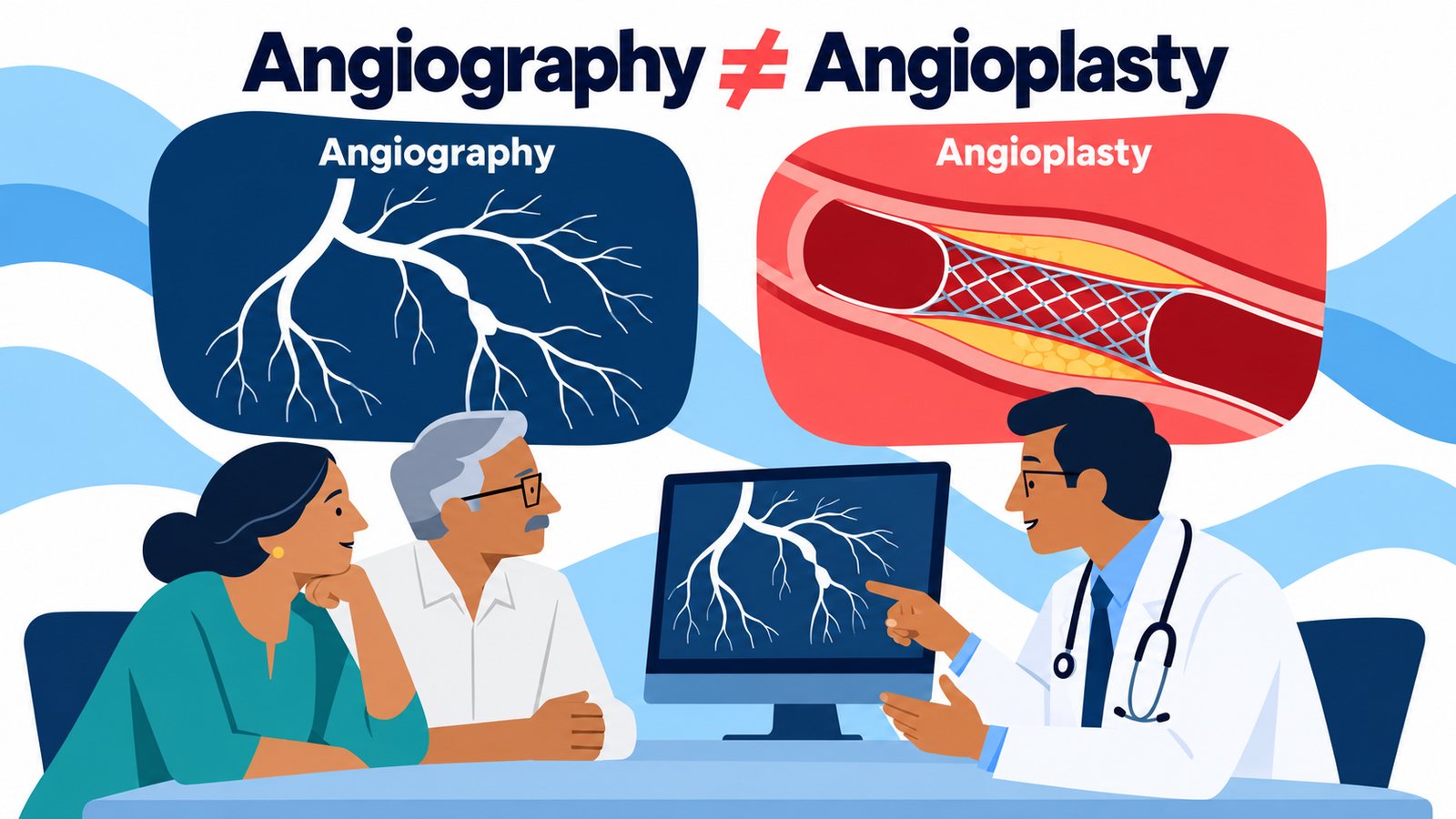
Coronary angiography is a test that shows narrowing or blockages in the arteries supplying your heart. Coronary angioplasty is a treatment that opens a selected narrowing or blockage, usually with a balloon and stent.
“Doctor, angiography karavani chhe ke angioplasty? Banne same chhe?”
The names sound similar, and both procedures use a thin tube passed through an artery at the wrist or groin. They can sometimes happen during the same procedure. But agreeing to an angiogram does not automatically mean agreeing to a stent. Before a planned angiogram, discuss what the team may do if they find a blockage.
Angiography vs Angioplasty: The Difference at a Glance
| Your question | Coronary angiography | Coronary angioplasty |
|---|---|---|
| What does it do? | Shows narrowing or blockages in the heart's arteries | Opens selected narrowing or blockages to improve blood flow |
| Will I be awake? | Usually yes | Usually yes |
| What anaesthesia is used? | Local anaesthesia; sedation may be offered | Local anaesthesia; sedation may be offered |
| Will my chest be opened? | No | No |
| Is a stent inserted? | No | Usually, but not always |
| Where is it done? | A cardiac catheterisation laboratory, or cath lab | A cardiac catheterisation laboratory, or cath lab |
| Can I go home the same day? | Often, after an uncomplicated planned test | Possible in selected planned cases; admission may be needed |
| Will I need medicines afterwards? | Depends on the findings and your existing conditions | Prescribed antiplatelet medicines are essential after a coronary stent |
| Does it cure coronary artery disease? | No; it is a diagnostic test | No; it treats a particular blockage, while the underlying disease still needs treatment |
If Angiography Shows a Blockage, Will I Definitely Need a Stent?
No. A blockage on an angiogram does not automatically need angioplasty or a stent. Some patients need medicines, some benefit from angioplasty, and others may be better served by bypass surgery.
“Blockage dekhayo etle stent mukavvo j padshe?”
The angiogram shows where an artery is narrowed and how severe the narrowing appears. The next decision is whether treating that narrowing will help you, and which treatment offers the most benefit for your situation.
Your cardiologist considers:
- Your symptoms: Chest discomfort on exertion, breathlessness and how much your daily activity is affected.
- Urgency: Whether this is stable coronary disease or an acute problem such as a heart attack.
- The artery involved: Where the narrowing lies and how much heart muscle it supplies.
- Blood flow: Whether the narrowing is restricting the supply of blood to the heart muscle.
- Other blockages: Their number, location and complexity.
- Your overall health: Heart pumping strength, kidney function, diabetes, bleeding risk and other illnesses.
Does a 70% or 90% blockage always need a stent?
The percentage alone cannot answer this. It needs to be interpreted alongside your symptoms, the artery involved and the rest of the assessment.
For an intermediate narrowing whose effect on blood flow is uncertain, the cardiologist may use fractional flow reserve (FFR) or instantaneous wave-free ratio (iFR). These tests compare pressure measurements across a narrowing to help assess whether it is limiting blood flow enough to influence the treatment decision.
What is angioplasty expected to achieve?
During an ongoing heart attack caused by a suddenly blocked coronary artery, urgent angioplasty may restore blood flow and limit heart muscle damage.
In stable coronary disease, angioplasty may relieve angina that continues despite appropriate medicines. Whether a procedure also reduces future cardiac events or improves survival depends on the pattern of disease and the patient's condition. Some patients benefit more from bypass surgery; others can be treated with medicines without an immediate procedure.
Before a planned angioplasty, you should understand the expected benefit in your case. Is the aim to relieve symptoms, improve your outlook, or both?
What can happen after the angiogram?
| Finding | Possible next step |
|---|---|
| No important obstructive blockage | Review other causes of symptoms; medicines or further tests may still be needed |
| Stable disease suitable for medical treatment | Medicines, treatment of cardiovascular risk factors and follow-up |
| A blockage that needs treatment and is suitable for angioplasty | Balloon treatment, usually with a stent |
| Disease for which the best treatment is uncertain or complex | Discussion of medicines, angioplasty or bypass surgery, with a Heart Team when appropriate |
| An acute blockage causing an ongoing heart attack | Urgent treatment to restore blood flow |
These findings guide the discussion; they are not automatic treatment rules. When needed, a Heart Team brings interventional cardiologists and cardiac surgeons together to consider the options.
Can Angiography and Angioplasty Be Done Together?
Yes. Angioplasty can follow angiography during the same procedure when the findings, your condition and the consent discussion support proceeding. This is often called same-sitting angioplasty.
During a planned angiogram
If angiography is being done for stable symptoms, the team may recommend medicines alone, angioplasty during the same procedure, angioplasty on another day, or consideration of bypass surgery.
There may be good reasons to pause before treatment: the findings may need further discussion, the disease may be complex, or kidney function and contrast exposure may affect the plan. Performing angioplasty on another day does not necessarily mean something has gone wrong.
If same-sitting angioplasty is a possibility, discuss it before entering the cath lab. Ask what would make the team proceed and what would make them stop to review the options with you.
During a heart attack
If a coronary artery is suddenly blocked and causing an ongoing heart attack, urgent angiography followed by angioplasty may be needed. Waiting for an elective second opinion can be dangerous in this situation.
For possible heart attack symptoms, including persistent chest pain, sudden breathlessness, cold sweating or faintness, call 108 for an ambulance in Gujarat. Do not wait for a clinic appointment or a WhatsApp reply.
The emergency angioplasty page explains how treatment during a heart attack differs from a planned procedure.
Will I Be Awake? Will Angiography or Angioplasty Hurt?
Most patients are awake during coronary angiography and angioplasty. Local anaesthesia numbs the wrist or groin where the tubes enter. General anaesthesia is not routinely needed.
“Main hosh mein rahunga? Dard hoga kya?”
Being awake does not mean the procedure is performed without pain relief.
- Local anaesthesia numbs the entry site. The injection may sting briefly.
- Sedation may help you relax or feel sleepy. With light sedation, you can usually still respond to the team.
- General anaesthesia makes you unconscious. It is reserved for selected situations rather than routine coronary procedures.
You may feel pressure at the wrist or groin, but you generally do not feel the catheter moving inside your arteries. Contrast injection can cause a brief warm sensation. During angioplasty, balloon inflation may temporarily cause chest discomfort.
Tell the team immediately if you have pain, breathlessness, dizziness or other discomfort. You do not need to silently tolerate pain because you are in the cath lab.
What Happens During Each Procedure?
A cardiac catheterisation laboratory, usually called a cath lab, is a hospital room with X-ray equipment and systems to monitor your heart rhythm, blood pressure and oxygen levels.
Coronary angiography: Taking pictures of the arteries
After numbing the wrist or groin, the cardiologist introduces a thin tube called a catheter through an artery and guides it towards the heart. Contrast dye is injected into the coronary arteries, and moving X-ray images show their outline and any narrowing.
The examination is called coronary angiography; the images are often called a coronary angiogram. Patients also commonly use “angiogram” to mean the test itself.
Angiography does not remove or open a blockage. The images help guide what happens next. Keep your written report and a copy of the angiogram recording for follow-up or a second opinion.
The coronary angiography page covers the test in more detail.
Coronary angioplasty: Opening a selected blockage
When angioplasty is appropriate, a fine wire is passed across the narrowing. A small balloon is advanced over the wire and inflated to widen the passage. A stent is usually expanded inside the artery to support it and keep it open.
A drug-eluting stent is a small metal mesh tube that releases medicine to reduce re-narrowing at the treated site. The balloon is removed; the stent stays permanently inside the artery.
Angioplasty is also called percutaneous coronary intervention (PCI): treatment of a coronary artery through a catheter, without opening the chest.
In selected cases, a drug-coated balloon can treat a narrowing without leaving a permanent stent. Suitability depends on the blockage and how the artery responds during treatment. A stent may still be needed if the balloon result is unsatisfactory.
The angioplasty and stents page explains the procedure, while the drug-coated balloon page covers when treatment without a stent may be suitable.
Which Procedure Is Riskier?
Angioplasty adds treatment steps to the risks of diagnostic angiography. The actual risk depends on your condition and the complexity of the procedure. An uncomplicated planned angiogram and emergency angioplasty during a major heart attack are very different situations.
Possible complications of either procedure include bleeding or swelling at the entry site, blood-vessel injury, a contrast reaction, kidney injury and heart rhythm disturbances. Rare serious complications include heart attack, stroke or death.
Angioplasty also carries risks from treating the coronary artery itself, such as a tear in the vessel wall or sudden vessel closure. After stenting, a clot can form inside the stent, or the treated segment can become narrow again.
Before a planned procedure, discuss how your kidney function, other illnesses, bleeding risk and coronary anatomy affect your risks.
How Long Is the Hospital Stay, and What Is Recovery Like?
After an uncomplicated planned coronary angiogram, going home the same day is often possible. Overnight observation may be needed in some cases.
After planned angioplasty, discharge may be possible the same day or the following day in selected uncomplicated cases. More complex procedures or other medical concerns can require a longer stay.
After a heart attack, hospital stay and recovery depend on the heart attack as well as the angioplasty. Heart muscle damage, pumping strength, rhythm problems and other complications can mean several days in hospital.
The wrist or groin entry site also affects your activity instructions. Before discharge, get a clear plan for wound care, lifting, exercise, driving, work and follow-up. Arrange for someone to take you home.
After a coronary stent, take antiplatelet medicines exactly as prescribed. These medicines reduce the risk of a clot forming inside the stent. Do not stop them on your own, including before dental work or another operation.
You will also need ongoing treatment for coronary artery disease, which may include cholesterol-lowering medicines and management of blood pressure, diabetes and smoking.
Seek urgent medical attention for severe or persistent chest pain, significant bleeding that does not stop with firm pressure, fainting, or a cold, pale or numb arm or leg on the side used for the procedure.
The recovery and follow-up guide provides further aftercare information.
Questions to Ask Before a Planned Procedure
- Am I having angiography only, or could angioplasty follow immediately? Make sure the consent discussion covers both if both are possible.
- Why is this needed now? Understand whether the procedure is urgent or whether there is time to discuss options.
- If a blockage is found, what would make you recommend a stent? Ask what benefit treatment is expected to offer you.
- Could medicines or bypass surgery be more suitable? The answer depends on your symptoms, coronary anatomy and overall health.
- What pain relief or sedation is planned? Tell the team if you are particularly anxious or have had problems with sedation before.
- What medicines will I need afterwards? Discuss antiplatelet treatment, bleeding concerns and any other planned procedures.
- What does the hospital estimate include? Clarify angiography, angioplasty, stents, additional devices, hospital stay, insurance coverage and costs if the plan changes or complications occur.
Tell the team about kidney disease, previous contrast reactions, diabetes, bleeding problems and all medicines you take, especially blood-thinning medicines.
Do not fast or stop regular medicines simply because someone else was told to do so. Instructions depend on the procedure, sedation plan, medicines and hospital protocol. Follow the instructions your treating team gives you.
The procedure preparation guide explains what reports and information to bring.
When Is a Second Opinion Useful Before Angioplasty?
A second opinion can help when angioplasty has been recommended for stable coronary disease and you are unsure why it is needed, several arteries are involved, or you are weighing angioplasty against bypass surgery.
Bring the angiogram recording as well as the written report. The report summarises the findings; reviewing the actual images helps the cardiologist assess the treatment options.
Dr. Kulin personally reviews the available reports and angiogram images before discussing whether medicines, angioplasty, bypass surgery or further assessment may be appropriate.
If you have ongoing chest pain at rest or other unstable symptoms, seek urgent medical assessment. A routine second-opinion appointment should not delay emergency care.
Frequently Asked Questions
Is an angiogram the same as CT coronary angiography?
No. In catheter coronary angiography, a tube enters through an artery at the wrist or groin and contrast is injected directly into the coronary arteries. CT coronary angiography uses a CT scanner, with contrast injected through a vein, usually in the arm.
Angioplasty cannot be performed during a CT scan. The appropriate test depends on your symptoms and clinical assessment.
Can angioplasty be done without a stent?
Yes, in selected cases, including some that can be treated with a drug-coated balloon. A stent remains appropriate for many blockages. Avoiding a stent is not automatically a better result.
Can a 75-year-old patient undergo angioplasty?
Yes. Age alone does not rule out angioplasty. The decision takes account of frailty, kidney function, other illnesses, the coronary arteries, the patient's wishes and the expected benefit and risk.
How much does angiography or angioplasty cost in Ahmedabad?
The cost depends on the hospital, whether treatment follows the angiogram, procedure complexity, the stents or other devices needed and the hospital stay.
For a planned procedure, request an itemised estimate. Ask what insurance covers and what additional expenses could arise if the findings change the treatment plan.
Can I refuse angioplasty after my angiography?
You can ask questions, discuss alternatives and decline a recommended procedure. Before an elective angiogram, clarify whether you are consenting to angiography alone or also to angioplasty if suitable.
Ask the team to explain the risks of postponing or declining treatment in your particular situation. During a heart attack or another unstable condition, delay can be dangerous.
If my angiography is normal, why am I still having chest pain?
An angiogram without obstructive blockages does not rule out every heart-related cause of pain. Problems in the smaller heart blood vessels or spasm of a coronary artery may need further assessment. Chest pain can also come from non-cardiac causes.
Persistent or changing symptoms deserve review; the next tests depend on the pattern of symptoms and the findings so far.
If a stent is inserted, will I need medicines for life?
Antiplatelet treatment is essential after coronary stenting, but the combination and duration are individualised according to the reason for treatment, bleeding risk and other conditions.
Some cardiovascular medicines may continue long term because a stent does not cure the underlying coronary artery disease. Review changes with your treating cardiologist rather than stopping medicines yourself.
Can an artery become narrow again after angioplasty?
Yes. Re-narrowing can occur in the treated segment, and new blockages can develop elsewhere. Drug-eluting stents reduce re-narrowing at the treated site, but continued medicines and treatment of cardiovascular risk factors remain necessary.
Advised Angioplasty? Bring Your Angiogram for Review
For a planned treatment decision, bring your angiography report, the angiogram recording, other heart test results and current medicines. The consultation can address whether a stent is needed, what benefit to expect and which alternatives are suitable.
Dr. Kulin Sheth, MD, DrNB Cardiology, is an interventional cardiologist in Ahmedabad. Consultations are available at Sheth Heart Clinic, Bopal; coronary angiography and angioplasty are performed in a hospital cath lab in Ahmedabad.
Sheth Heart Clinic
818, 8th Floor, Anam 2, Beside Vakil Sahib Bridge, Next to Amrapali Axiom, Bopal Ambli T Junction, Ahmedabad 380058.
Call: +91 97255 51563
WhatsApp: +91 97255 51563
For possible heart attack symptoms, call 108 for an ambulance rather than arranging a routine consultation.
Medical References
- European Society of Cardiology: 2024 Guidelines for the Management of Chronic Coronary Syndromes
- American College of Cardiology: Key Perspectives on the 2021 Coronary Revascularization Guideline
- American Heart Association: 2025 Guideline for the Management of Acute Coronary Syndromes
- NHS: What Happens During Angiography
- NHS: How Coronary Angioplasty Is Performed
- NHS: Recovery After Coronary Angioplasty
- National Heart, Lung, and Blood Institute: Care After a Stent
- Ahmedabad District, Government of Gujarat: Ambulance Helpline



Google Reviews
Read what our patients say about us
Book a Consultation
Reach Dr. Kulin Sheth's team directly by phone or WhatsApp, or visit us at Sheth Heart Clinic, Bopal.