
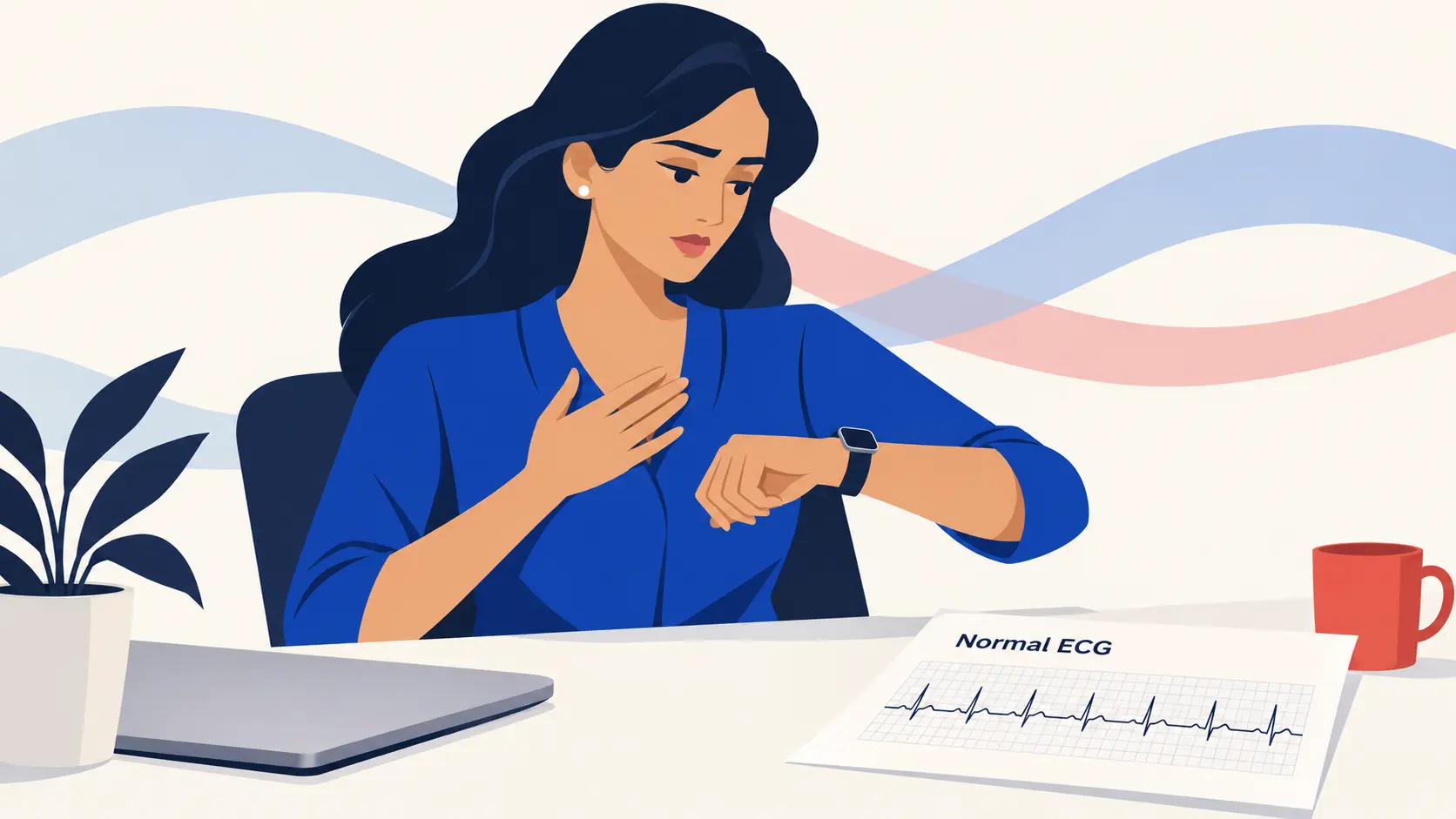
My heart races, but my ECG is normal. How do we find the cause?
23
Oct
My heart races, but my ECG is normal. How do we find the cause?
Medically reviewed by Dr. Kulin Sheth, MD, DrNB Cardiology.
Medically reviewed on: 22 October 2026.
A normal electrocardiogram, or ECG, between episodes does not rule out an intermittent heart rhythm problem. An ECG records the heart’s electrical activity for a brief period. Finding the cause of recurrent palpitations may require a longer recording, such as a Holter monitor, chosen according to how often symptoms occur and how concerning they are.
When should I seek urgent help?
Seek emergency care if a racing heartbeat comes with chest pain or pressure, severe breathlessness, fainting, collapse, or marked ongoing dizziness with weakness. In Gujarat, call 108; elsewhere, contact local emergency services. Do not drive yourself if you feel faint or unwell, or wait for a watch recording, clinic appointment or WhatsApp reply.
Episodes during exertion, near-fainting, known heart disease or a family history of sudden unexplained death need timely assessment even if the heartbeat has settled.
How can my ECG be normal if I felt my heart racing?
Think of a resting ECG as a screenshot of your heart’s electrical activity during a short recording window. If the episode ended before the recording began, the ECG may show a normal rhythm. It cannot show every event that happened earlier or predict every event that might happen later.
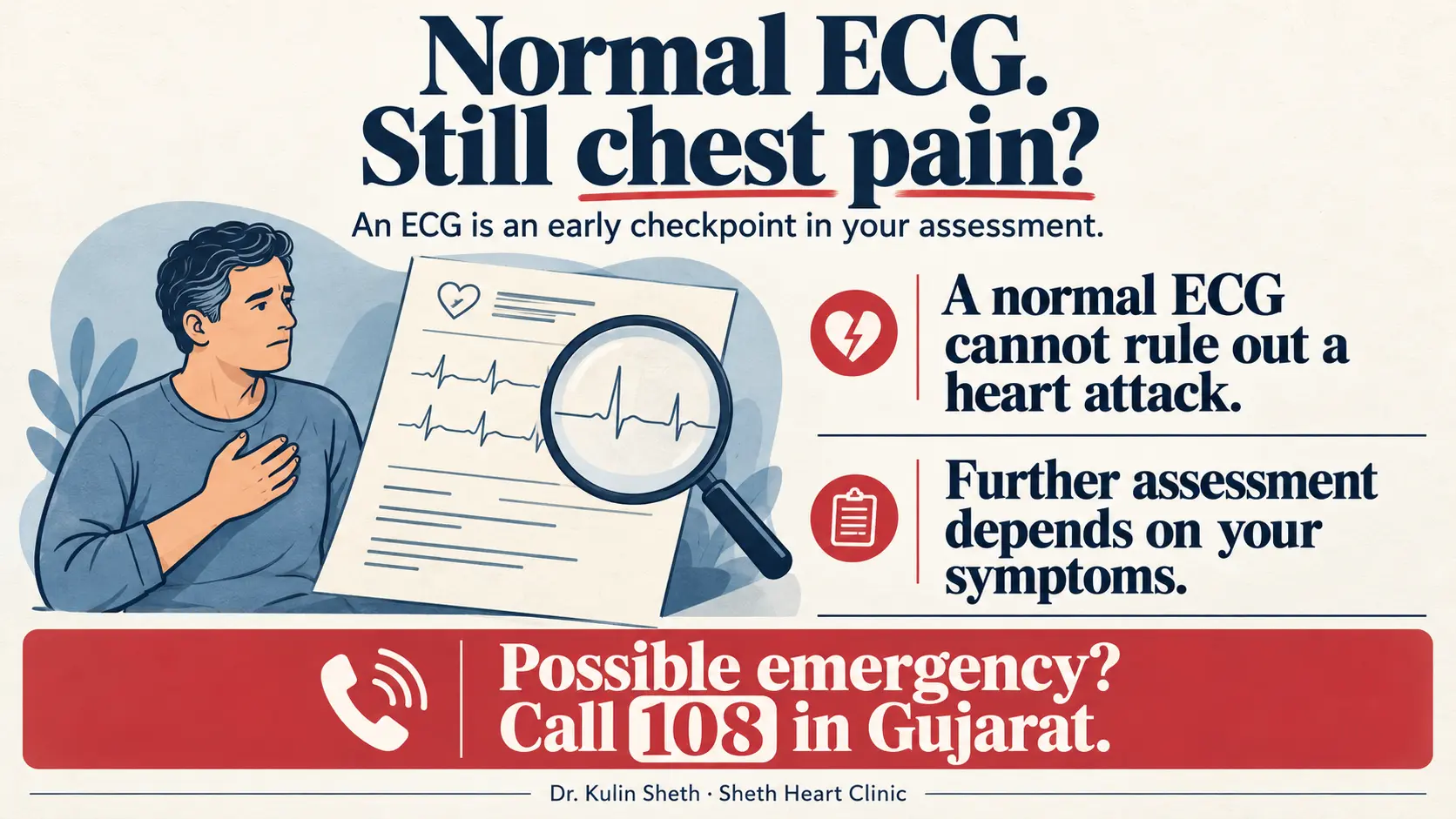
An ECG can still reveal useful clues between episodes. It is an important first test, even when longer monitoring is needed. A normal ECG also cannot exclude every acute heart problem, including a heart attack; concerning symptoms need assessment on their own merits.
Palpitations mean noticing a racing, pounding, fluttering or skipping heartbeat. An arrhythmia means an abnormal heart rhythm. The sensation alone does not establish which rhythm is occurring. The broader palpitations and arrhythmias guide explains common causes and diagnoses.
Yeh kis wajah se hota hai?
What can bring on palpitations?
Heavy meals, caffeine, work or exam stress, and poor sleep can bring on palpitations in some people. They may make the heart beat faster, make extra beats more noticeable or trigger an underlying rhythm problem. The trigger alone cannot tell us which of these is happening.
- Heavy meals: Pet bhar ke khaane ke baad dhadkan zyada mehsoos ho sakti hai. Some people notice pounding or racing after a large meal. If this happens repeatedly, note the meal size and timing; smaller portions may help. Do not assume chest discomfort or palpitations after eating are simply gas or acidity.
- Tea, coffee and energy drinks: Caffeine affects people differently. Exam ke liye jagna, baar-baar chai ya coffee peena, aur neend kam hona can occur together. If episodes repeatedly follow caffeine, reducing the amount and tracking symptoms is reasonable. Everyone with palpitations does not need to give up tea or coffee completely.
- Work pressure, exams and emotional stress: Deadline ho ya exam ka tension, the body’s stress response can speed up the heartbeat. Stress can also make you more aware of it. That does not establish that every episode is anxiety-related; an arrhythmia and anxiety can coexist.
- Poor sleep, dehydration and illness: Late nights, fever or dehydration can contribute to a faster heartbeat. Note these alongside the episode rather than assuming they fully explain recurrent symptoms.
- Nicotine, alcohol and cannabis: Tell your doctor about smoking, vaping, nicotine pouches such as ZYN, alcohol, and cannabis, also called weed or marijuana. Cannabis can increase heart rate, and alcohol can trigger atrial fibrillation in susceptible people. Note the product, amount and timing if symptoms follow use. Doctor ko khul kar batayein ki kya liya tha aur kitni der baad dhadkan shuru hui. This information helps guide assessment.
- Some medicines and supplements: Certain cold remedies, inhalers and stimulant-containing supplements may contribute. Bring the product names and doses for review; do not stop prescribed medicines on your own.
Sometimes there is no obvious trigger. Keep a brief record of what happened before an episode, but do not deliberately repeat a suspected trigger to test it. A familiar trigger does not make an episode safe if it comes with the warning signs described above.
Which details help the doctor choose the next step?
The pattern of the episodes helps guide investigation. Useful details include:
- How often they happen and how long they last.
- Whether they start and stop suddenly or change gradually.
- Whether the heartbeat feels regular or uneven.
- Whether they occur at rest, on standing or during exertion, and any associated faintness, chest discomfort or breathlessness.
- Medicines, inhalers, cold remedies, supplements, energy drinks and other possible contributors.
Previous heart conditions and relevant family history also matter. Bring earlier ECGs, especially any recorded during symptoms.
What does a Holter monitor do?
A Holter monitor continuously records your heart’s electrical activity while you go about your day and sleep. The recording is analysed to identify rhythm changes and relate them to the times you felt symptoms. Automated analysis assists the process; the report and relevant tracings need clinical interpretation.
Unlike a brief ECG, it can capture what happens outside the consultation. The recording period should give a reasonable opportunity to capture the usual episode.
| Monitoring option | When it may help | Main limitation |
|---|---|---|
| Short Holter, commonly 24–48 hours | Frequent symptoms likely to occur during that period | An occasional episode may not happen while it is worn |
| Longer continuous ECG patch | Intermittent symptoms needing a longer recording window | Wear duration, recording quality and features vary by device |
| External event or loop recorder | Less frequent episodes requiring recording over a longer period | Some depend on activation; automatic detection and storage vary |
| Implantable loop recorder, placed under the skin | Selected infrequent but concerning events, particularly unexplained fainting | Requires a minor procedure and specialist selection; not routine for ordinary palpitations |
Frequency is only one factor. The severity of symptoms, suspected rhythm and ability to activate a recorder also affect the choice.
What are patch Holters, and can the doctor review them remotely?
Patch Holters are small adhesive ECG recorders worn on the chest. Depending on the model, they can record for several days or longer without the separate wires used by a conventional Holter. This can make a longer recording more practical.
Remote review depends on the system:
- Store-and-analyse systems retain the recording for download and review afterwards.
- Connected systems can transmit recordings through a phone or gateway for remote review. Some services include alerts for selected findings.
Remote monitoring can help the doctor assess rhythm information recorded away from the clinic. It does not automatically mean someone is watching every heartbeat live. Confirm who reviews the data, how quickly it is reviewed and how important findings are communicated.
Follow the particular device’s instructions for bathing, exercise and skin care. Emergency symptoms still require emergency care.
What if the monitor report is normal?
The meaning depends on whether your usual symptoms occurred during a usable recording.
If the typical episode was captured: A normal rhythm at that time can make an important rhythm disturbance less likely as the explanation for that episode. The doctor can then consider other contributors. The symptoms are still real, and different types of episodes may need separate assessment.
If no typical episode occurred: The recording may provide useful information without answering the original question. Depending on your history and risk, the next step may be observation, longer monitoring or another assessment. A quiet recording period does not prove that every future episode will be harmless.
Can Apple Watch or Galaxy Watch Ultra help find an arrhythmia?
Yes. On supported models with the appropriate features enabled, an Apple Watch or Samsung Galaxy Watch Ultra can help capture information that would otherwise be lost before a clinic visit. Their ECG functions are particularly useful in assessing possible atrial fibrillation, or AF, an irregular rhythm involving the heart’s upper chambers.
Three outputs mean different things:
- A heart-rate number estimates how fast the heart is beating, without identifying the rhythm by itself.
- An irregular-rhythm alert uses pulse information to flag possible AF. It is a reason for review, rather than a confirmed diagnosis.
- An ECG tracing records an electrical signal that a clinician can examine. A sufficiently clear tracing may support a diagnosis; further recording may still be needed.
Save the actual ECG report or PDF with its date, time and associated symptoms. A screenshot of a heart-rate number provides less information than the tracing.
Watch ECGs are short recordings from one electrical view of the heart, called a single lead. They do not replace a standard ECG or continuous medical monitoring, cannot reliably detect every arrhythmia, and cannot rule out a heart attack. Automated labels can be incorrect or inconclusive.
These ECG features are available in India on supported devices, subject to current requirements. Apple’s ECG app requires a compatible Apple Watch and paired iPhone and excludes Apple Watch SE. Samsung Health Monitor requires a compatible Galaxy Watch and Samsung Galaxy smartphone. Both manufacturers specify that their ECG apps are not intended for people under 22. Software, region and setup requirements also apply.
Will I need blood tests, an echo or a treadmill test?
Additional tests depend on the suspected cause. Blood tests may look for anaemia, thyroid disease or electrolyte disturbances. An echocardiogram checks the heart’s structure and pumping function. A supervised exercise test may help investigate selected exertional symptoms.
These tests answer different questions. An echo does not replace a rhythm recording, and everyone with palpitations does not need every test. The cardiac tests guide explains their roles and limitations.
Could I need an EP study or ablation?
Selected patients may benefit from an electrophysiology study, often called an EP study. Thin catheters passed through blood vessels record electrical signals inside the heart and help identify the mechanism of a suspected arrhythmia.
If suitable, catheter ablation can treat the tissue or electrical pathway responsible, sometimes during the same procedure. These procedures are performed by an electrophysiologist, a cardiologist specialising in heart rhythm disorders.
An EP study is not necessary for every palpitation. Depending on the diagnosis, options may include observation, treatment of contributing conditions, medicines or ablation. Expected benefits, risks and the chance of recurrence vary with the rhythm and individual circumstances.
What should I record before my appointment?
Keep a brief symptom diary with the date, time, duration, activity and associated symptoms. Add any available pulse reading or ECG tracing, clearly identifying the device used. If your prescribed monitor has a symptom button, use it as instructed.
Bring the original records, full monitoring reports, earlier ECGs and current medicine and supplement list. Do not deliberately provoke an episode to obtain a recording.
Frequently asked questions
Can anxiety cause palpitations even if another problem is present?
Yes. Anxiety can make the heartbeat faster or more noticeable, and it can coexist with an arrhythmia. Recurrent symptoms deserve assessment rather than assuming the cause from a normal ECG alone.
Do I need to buy a smartwatch?
No. If you already have a compatible watch, its recordings may help. Medical monitoring should be chosen around the clinical question; buying a watch is not a prerequisite for investigation.
Should I stop my medicines before monitoring?
Only if your treating clinician specifically instructs you to. Bring your medicine list and follow the agreed plan rather than changing treatment to make an episode more likely.
What if an episode is too brief to record on my watch?
Tell your doctor. A continuous or loop recorder may be more suitable than a device you must activate after symptoms begin. Do not delay urgent care while trying repeatedly to capture a tracing.
Still having episodes without a clear explanation?
A consultation or non-emergency second opinion can help clarify whether the existing recordings answer your question and whether a different monitoring approach would help. Dr. Kulin personally reviews available reports and recordings before deciding whether further assessment is needed.
Book a cardiologist consultation with Dr. Kulin Sheth at Sheth Heart Clinic, Ahmedabad. Bring what has already been recorded, even if the report was described as normal.
Sheth Heart Clinic: 818, 8th Floor, Anam 2, Beside Vakil Sahib Bridge, Next to Amrapali Axiom, Bopal Ambli T Junction, Ahmedabad 380058.
Call: +91 97255 51563
WhatsApp: +91 97255 51563
References
- ISHNE–HRS expert consensus on ambulatory ECG and external cardiac monitoring, 2017
- Japanese Heart Rhythm Society / Japanese Circulation Society consensus on appropriate use of ambulatory and wearable ECG devices, 2025
- ISHNE/HRS/EHRA/APHRS collaborative statement on mobile health in arrhythmia management, 2021
- ACC/AHA/HRS guideline on adult supraventricular tachycardia: EP study and catheter ablation, 2015
- Apple Support India: taking an ECG with Apple Watch, compatible models and limitations
- Samsung India: Samsung Health Monitor ECG, irregular-rhythm notifications and eligibility
- NHS: heart palpitations, common triggers and when to seek help
- British Heart Foundation: palpitations after meals and other possible triggers
- American Heart Association scientific statement: cannabis and cardiovascular health
- ACC/AHA/ACCP/HRS atrial fibrillation guideline, 2023: alcohol and rhythm management
Google Reviews
Read what our patients say about us
Book a Consultation
Reach Dr. Kulin Sheth's team directly by phone or WhatsApp, or visit us at Sheth Heart Clinic, Bopal.