Do I need a heart check-up before joining the gym?
24
Oct
Do I need a heart check-up before joining the gym?
Dr. Kulin Sheth’s personal recommendation is to have a cardiologist assessment before joining a gym. The assessment considers your symptoms, medical and family history, current activity and the training you plan to do. A treadmill stress test may form part of that assessment, depending on what needs checking. A normal result can help inform exercise advice, but it cannot exclude every dangerous condition or guarantee protection from a future heart event.
Reports of people dying during a gym workout or a marathon raise a direct question: why can someone who looks fit die during exercise? These deaths do happen. Underlying heart disease, a dangerous heart rhythm and, in some cases, performance-enhancing drug use can be involved. Understanding those causes helps explain both the value and the limits of a pre-exercise assessment.
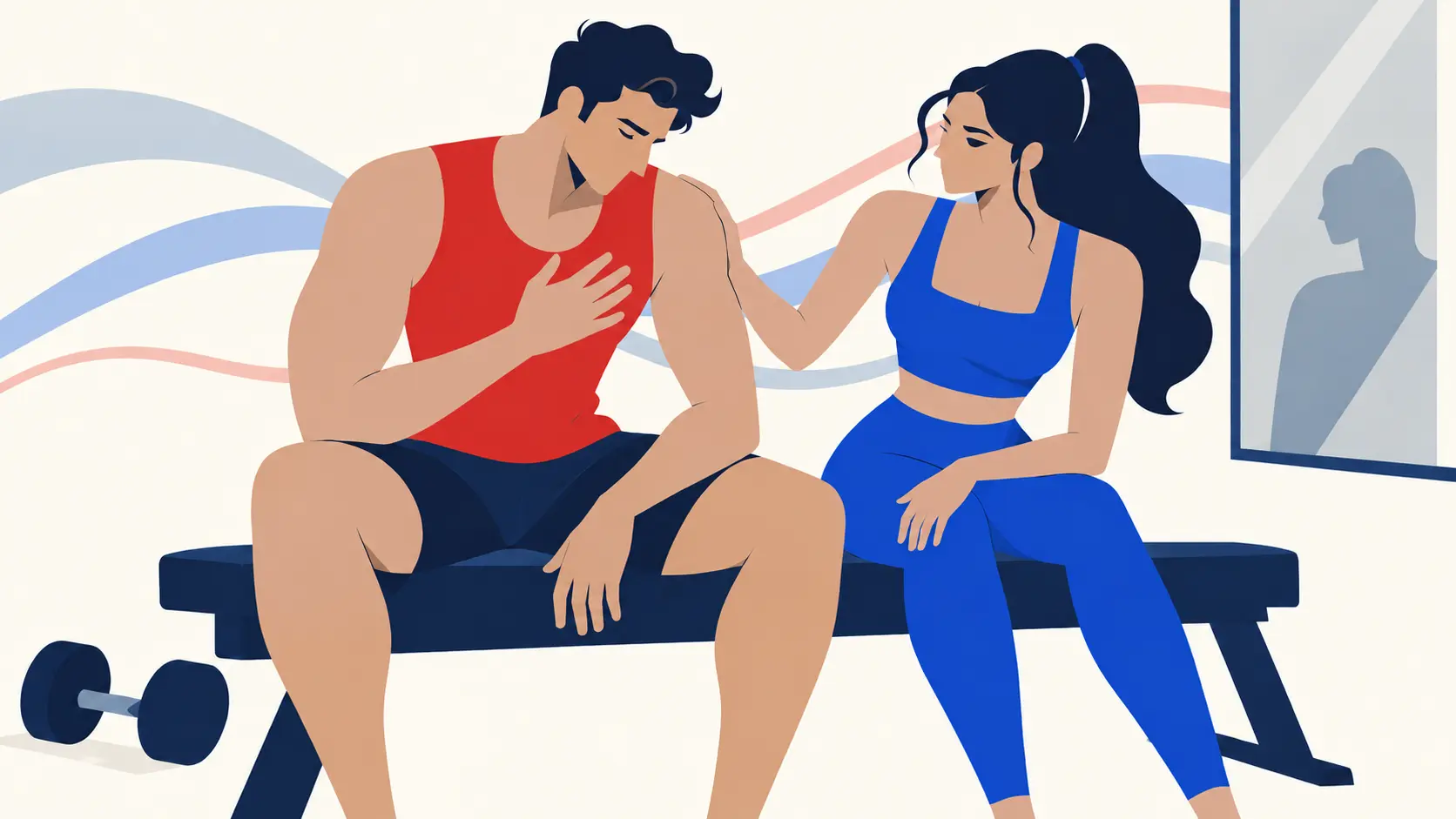
Why do some people die in the gym despite looking fit?
One way a workout becomes fatal is sudden cardiac arrest: the heart develops a dangerous rhythm and stops pumping blood effectively. Without immediate treatment, the brain and other organs lose their blood supply. Cardiac arrest describes what happens; the next question is what caused it.
Possible underlying causes include:
- Coronary artery disease and heart attack. Fatty deposits called plaques can develop in the arteries supplying the heart, including in people who exercise regularly. If a plaque disrupts and a clot blocks blood flow, a heart attack can trigger a fatal rhythm. Some people have not previously recognised symptoms.
- Heart-muscle disease. Conditions such as hypertrophic cardiomyopathy, in which the heart muscle becomes abnormally thick, can create a risk of dangerous rhythms. Someone may look athletic and have few or no recognised symptoms.
- Inherited electrical disorders. Conditions such as long QT syndrome affect the electrical signals controlling the heartbeat. Some can trigger dangerous rhythms during exercise even when the heart's pumping function appears normal.
- Performance-enhancing drugs. Non-medical use of certain hormones and other drugs can damage the heart or create conditions that favour a heart attack or dangerous rhythm. The specific drugs and risks are explained below.
- Aortic emergencies. A tear in the wall of the body's main artery, called an aortic dissection, can be fatal. Heavy straining is particularly concerning in people with underlying aortic disease; a normal treadmill test does not exclude this risk.
These are different diagnoses, requiring different assessments. A single normal ECG, echo or treadmill test cannot exclude them all.
Collapse and sudden death in long-distance runners
Endurance fitness does not prevent coronary disease or eliminate the possibility of a dangerous heart rhythm. Cardiac arrest can occur during a marathon or half-marathon, including in experienced runners. Other life-threatening causes of collapse include exertional heatstroke and severe disturbances in the body's salts, such as sodium. Collapse in a runner therefore needs prompt assessment rather than an assumption that it is ordinary exhaustion or dehydration.
Identifying the cause of an individual death may require medical records, a post-mortem examination and sometimes toxicology or genetic testing. It cannot be established from the person's physique or a video. Regular exercise remains beneficial, but it does not make someone immune to these emergencies.
Steroids, performance-enhancing drugs and heart risk
Yes. Some recreational gym users, bodybuilders and endurance athletes use performance-enhancing drugs. Their cardiovascular effects can contribute to serious illness and potentially fatal events. This is a recognised risk, although it does not establish drug use as the cause of any particular person's death.
Examples include:
| Drug or group | How misuse can affect the heart or circulation |
|---|---|
| Anabolic-androgenic steroids, including testosterone, nandrolone, stanozolol, trenbolone and oxandrolone | Non-medical use can raise blood pressure, worsen cholesterol and contribute to coronary disease and abnormal heart-muscle thickening or dysfunction. Steroid misuse has also been linked to sudden cardiac death, although proving its precise contribution in individual cases can be difficult. |
| Clenbuterol, used by some people for fat loss or physique enhancement | Can cause a rapid heartbeat, palpitations and low blood potassium. Reported poisoning cases include heart injury and dangerous cardiac complications. It is not an anabolic steroid. |
| Erythropoietin, or EPO, misused to increase endurance | Raises red blood cell production. Misuse can increase blood thickness and clotting risk, with potentially serious consequences for the heart and brain. |
High-dose bodybuilding use of testosterone is different from prescribed replacement treatment for a diagnosed deficiency. Protein powder and creatine are also different from anabolic steroids; these products should not be grouped together simply because they are used in a gym.
Tell your cardiologist exactly what you take, including injections, tablets and products described as a “cycle”, “fat burner” or “testosterone booster”. Bring packaging or photographs of labels. A normal TMT does not make continued drug misuse safe. If you use anabolic steroids, seek medical help with stopping rather than following an online withdrawal or “post-cycle” regimen.
Warning symptoms during exercise
Stop exercising if you develop chest discomfort, unexplained faintness, unusual breathlessness or a racing heartbeat that makes you feel unwell. Do not repeat the workout to see whether the symptoms happen again.
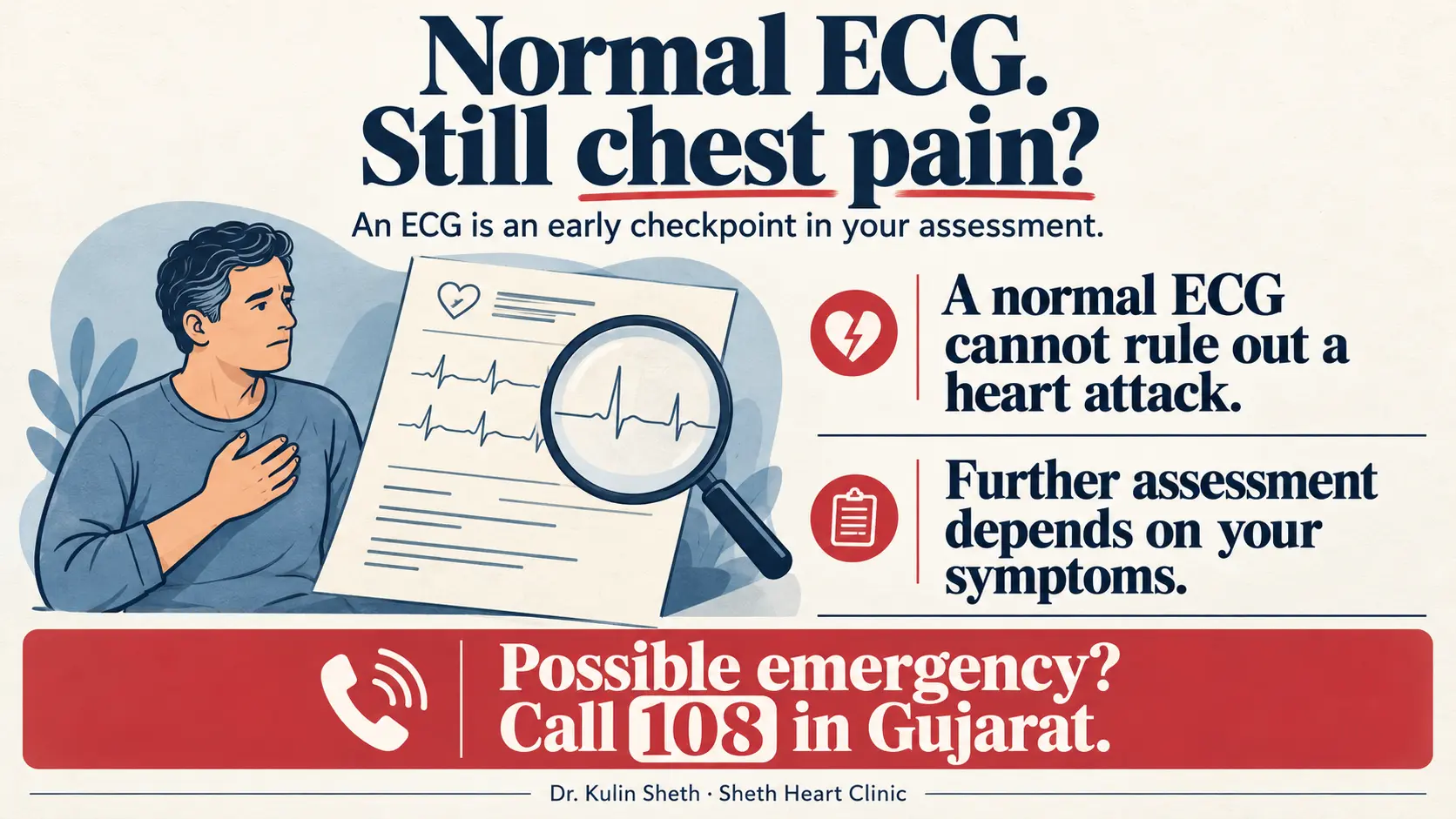
Seek emergency care for chest pressure or discomfort with sweating, breathlessness or faintness; severe breathlessness; collapse; or sudden severe chest or back pain. Symptoms need not be dramatic to be serious. In Gujarat, call 108; elsewhere, contact local emergency services. Do not wait for a routine appointment or a WhatsApp reply.
If an adult collapses, is unresponsive and is not breathing normally, including only gasping, treat this as suspected cardiac arrest. Call for emergency help, begin cardiopulmonary resuscitation (CPR) with firm, fast chest compressions in the centre of the chest, and have someone bring an automated external defibrillator (AED), a device that checks the rhythm and gives a shock when needed. Follow its prompts and the emergency dispatcher’s instructions. Do not wait for a diagnosis before acting.
Recurring symptoms during exertion need assessment even if they settle with rest. Mention:
- Chest pressure, heaviness or discomfort when running, cycling or lifting.
- Fainting, especially during exercise, or unexplained near-fainting.
- Breathlessness that seems excessive for the effort, or a clear fall in your usual exercise capacity.
- Palpitations associated with dizziness, chest discomfort or an abrupt change in exercise tolerance.
Do not assume these symptoms are simply poor stamina, acidity or anxiety. Equally, symptoms alone cannot establish a heart diagnosis.
Your assessment before starting gym training
The consultation establishes what needs investigation and what activity advice fits your situation. It begins with a discussion and examination, rather than a fixed list of tests.
At a cardiologist consultation with Dr. Kulin Sheth, relevant information includes:
- Your current activity and plans: starting gentle exercise, returning after years of inactivity, increasing training intensity, heavy lifting or preparing for a long-distance event.
- Symptoms and previous illness: including known heart disease, diabetes, kidney disease, previous procedures or a recent change in health.
- Family history: early heart attacks, unexplained sudden deaths, inherited heart-muscle conditions or known electrical disorders.
- Risk factors: blood pressure, cholesterol, tobacco use, blood sugar and weight-related cardiometabolic health.
- Medicines and other products: prescribed treatment, pre-workout supplements, energy drinks, nicotine and any anabolic steroid use.
Bring existing reports and prescriptions. Explain what your training actually involves. A short treadmill walk, repeated high-intensity intervals and a near-maximal weight lift place different demands on the body. Competitive sport may require a separate sports-specific assessment.
The role of a treadmill stress test
A treadmill stress test, or TMT, assesses how your heart responds to progressively increasing exercise. You walk on a treadmill while the team monitors your heart’s electrical tracing, blood pressure and symptoms.
It can help assess exercise capacity and identify findings such as electrical changes suggesting reduced blood supply, certain exercise-related rhythm disturbances or an abnormal blood-pressure response. The result is interpreted alongside your history, medicines, resting tracing and the workload achieved.
A TMT is not suitable for every person or every clinical question. Some symptoms or findings need a different investigation, or assessment before exercise testing is considered. An abnormal TMT does not by itself prove that a coronary artery is blocked.
Other tests answer different questions:
| Test | What it can help assess | Important limitation |
|---|---|---|
| Electrocardiogram, or ECG: a heart tracing | Electrical activity, rhythm and certain patterns suggesting heart disease | A brief recording may miss intermittent problems; a normal ECG does not exclude every heart condition. |
| Echocardiogram, or echo: a heart ultrasound | Heart-muscle structure, pumping function and valves; parts of the aorta may also be assessed | A routine resting echo does not map every coronary plaque or examine the entire aorta. |
| Treadmill stress test, or TMT | Symptoms, electrical changes, rhythm, blood pressure and exercise capacity during exertion | A normal result does not exclude every blockage, dangerous rhythm or future event. |
The guide to ECG, echo and treadmill testing explains what each test involves. Having a consultation does not automatically mean needing all three.
If my TMT is normal, can I assume my heart is safe?
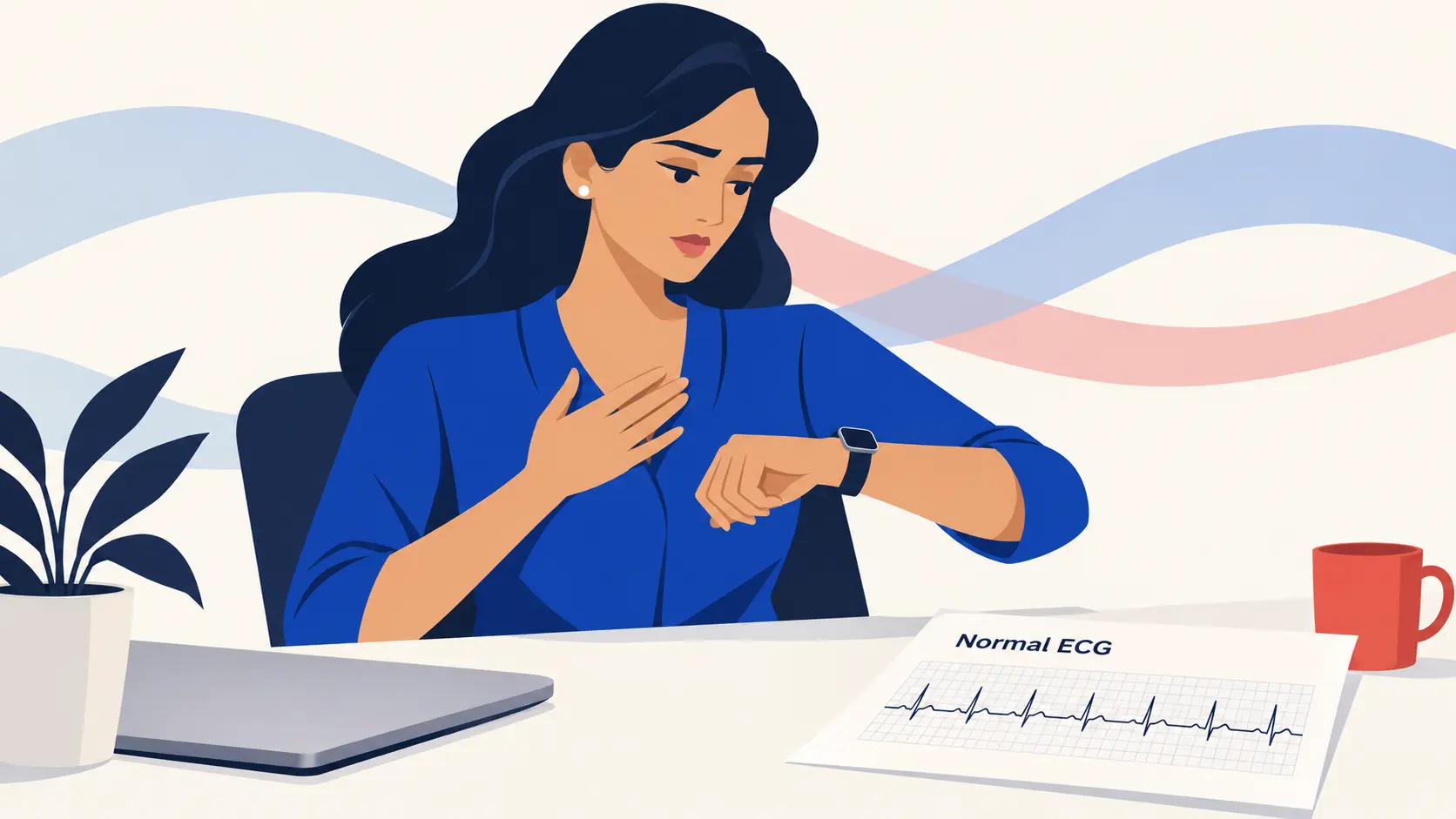
A normal TMT is useful information about your response to the exercise achieved during that test. It is not a permanent fitness certificate or a guarantee against a future heart attack or cardiac arrest.
Some coronary plaques do not restrict blood flow enough to cause an abnormal exercise tracing, yet can later disrupt and form a clot. Some rhythm problems are intermittent and may not occur during the test. Other conditions require different assessments.
That is why a normal report does not cancel new symptoms or the need to manage blood pressure, cholesterol, diabetes and tobacco exposure. If your symptoms change, seek advice rather than relying on an earlier result. The coronary artery disease page explains how plaques and heart attacks are connected.
Heavy lifting and aortic dissection
A normal treadmill test does not rule out aortic disease or predict whether a dissection will occur. The aorta is the main artery carrying blood from the heart. An aortic dissection happens when a tear allows blood to enter and separate layers of its wall; it is an emergency.
Very heavy lifting, particularly with sustained straining and breath-holding, can produce a sharp rise in blood pressure. This matters especially in people with an enlarged aorta, certain inherited conditions or other significant aortic disease. Such patients need specific advice about lifting and exercise intensity.
During isometric effort, muscles generate tension without much movement, as when holding a heavy load in a fixed position. Heavy resistance exercise may include this type of strain. It should not be treated as equivalent to ordinary, controlled strength training.
This does not mean everyone who lifts weights is likely to have a dissection. It means that a treadmill result cannot answer every question about heavy lifting. Tell your cardiologist about known aortic enlargement, a family history of dissection or advice you have previously received about lifting restrictions.
Sudden severe chest or back pain, especially with collapse, faintness or new weakness, needs emergency assessment even if earlier heart tests were normal.
Starting or returning to exercise gradually
Build up gradually from your current ability. If you have no concerning symptoms or known cardiovascular, metabolic or kidney disease, light to moderate activity can generally begin without waiting for a routine test. Dr. Kulin’s recommendation for a pre-gym assessment should not become a reason to remain inactive while arranging an appointment.
- Start at a manageable effort. Avoid making your first sessions all-out intervals, long endurance efforts or attempts at your heaviest lift.
- Increase training gradually. Build duration and consistency before making substantial increases in intensity or load.
- Learn technique and breathing. Use appropriate supervision for unfamiliar lifts and avoid prolonged breath-holding and straining.
- Respond to symptoms. Stop if concerning symptoms occur. Do not let a normal report or pressure to finish a set override them.
If you have an existing condition, recent procedure or previous exercise restriction, follow the individual plan agreed with your treating team. Heat, hydration needs and medicines can also affect exercise tolerance. People with prescribed fluid restrictions need individual advice rather than a generic instruction to drink more.
Are weights more dangerous than cardio?
Neither label tells us whether a workout suits you. Resistance training can improve strength and cardiometabolic health, while aerobic exercise supports endurance and cardiovascular fitness. Many people benefit from both.
The relevant questions are how hard you are working, your technique, your underlying health and whether you are progressing appropriately. Gentle resistance work is very different from maximal lifting; an easy cycle is very different from repeated all-out sprints.
Your training advice should also account for the medicines, stimulants or performance-enhancing drugs you have disclosed during assessment.
A second opinion on exercise restrictions and tests
Clarify the reason for the restriction and what decision each test is intended to inform. You may need a temporary pause, a change in intensity, treatment first or a supervised rehabilitation programme.
For a non-emergency second opinion, Dr. Kulin personally reviews existing reports and recordings before deciding whether further assessment is needed. Bring the original advice and describe the activity you hope to resume. Continue existing restrictions until they have been reviewed; urgent symptoms should never wait for a second opinion.
Frequently asked questions
My gym wants a fitness certificate. Does that mean I need an ECG, echo and TMT?
A request for a certificate does not determine which tests you need. Bring the gym’s requirements and details of the planned training. The assessment should establish what can reasonably be advised and whether any restrictions or investigations are needed. No certificate can promise that an exercise-related event will never happen.
My ECG and echo were normal last year. Should I repeat them before joining?
Not automatically. Whether reassessment or repeat testing is useful depends on new symptoms, changes in health, the earlier findings and your intended activity. Bring the original reports rather than assuming they must be repeated or that they provide lifelong clearance.
I take a beta blocker. Should I follow the treadmill’s target heart rate?
Beta blockers can reduce the heart-rate rise during exercise, so a generic target displayed on a machine or watch may be unsuitable. Ask for individual intensity advice. Do not skip or stop prescribed medicines to reach a target heart rate or prepare for a test unless the treating team specifically instructs you to do so.
Can I return to the gym after angioplasty?
Often yes, but timing, intensity and lifting restrictions depend on why angioplasty was needed, your recovery, heart function, access-site healing and current symptoms. After a heart attack, cardiac rehabilitation may provide a supervised route back to activity. Follow the treating team’s plan rather than restarting because you feel well or have a normal test report.
Discuss your exercise plans with Dr. Kulin Sheth
Discuss your training plans, symptoms and previous reports with Dr. Kulin Sheth at Sheth Heart Clinic in Ahmedabad. The consultation can help clarify whether tests are appropriate, what needs attention and whether your exercise plans require adjustment. You can also seek a second opinion about an unexplained restriction or a proposed investigation.
Sheth Heart Clinic: 818, 8th Floor, Anam 2, Beside Vakil Sahib Bridge, Next to Amrapali Axiom, Bopal Ambli T Junction, Ahmedabad 380058.
Call: +91 97255 51563
WhatsApp: +91 97255 51563
Medically reviewed by Dr. Kulin Sheth, MD, DrNB Cardiology.
Medically reviewed on: 24 October 2026.
References
American Heart Association: Exercise stress test, reviewed February 2025.
Kim and colleagues: Cardiac arrest during long-distance running races, JAMA, 2025.
American Heart Association: How beta blocker drugs affect exercise.
American Heart Association: What is cardiac rehabilitation?.
American Heart Association: Emergency treatment of cardiac arrest.
American College of Sports Medicine: Expert consensus statement on exertional heat illness, 2023.
Google Reviews
Read what our patients say about us
Book a Consultation
Reach Dr. Kulin Sheth's team directly by phone or WhatsApp, or visit us at Sheth Heart Clinic, Bopal.